
info@splittek.com
It is a numerical methodfor solving problems of engineering and mathematical physics. Useful for problems with complicated geometries, loadings, and material properties where analytical solutions can not be obtained.
| This process is at the core of mechanical engineering, as well as a variety of other disciplines. It also is one of the key principles used in the development of simulation software. Engineers can use these FEM to reduce the number of physical prototypes and run virtual experiments to optimize their designs. Complex mathematics is required in order to understand the physical phenomena that occur all around us. These include things like fluid dynamics, wave propagation, and thermal analysis. Analyzing most of these phenomena can be done using partial differential equations, but in complex situations where multiple highly variable equations are needed, Finite Element Analysis is the leading mathematical technique. 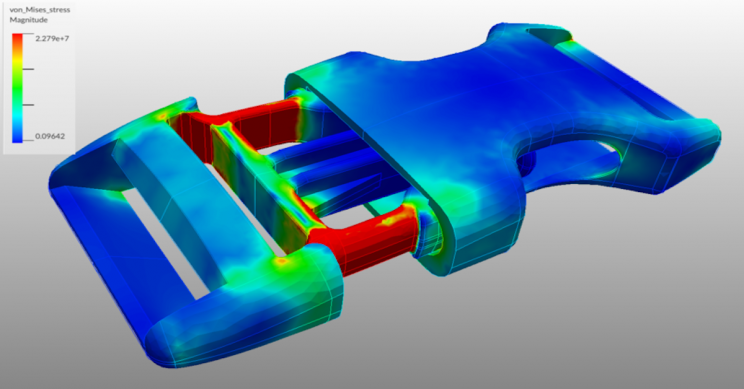
|
FEA-based simulations are used to serve different design purposes.
| Two basic design activities are design analysis and design synthesis. In design analysis, all the design variables and system parameters are given; an FEA model is to find the system state or response to external loads. It is a type of task for design analysis, which is commonly referred as what–if simulation. In design synthesis, some design variables are to be determined based on the specified design criteria. In other words, design variables are given as changeable ranges rather than values, FEA models are applied to evaluate the responses of a system; although design variables can vary in a design space. FEA results for different scenarios are compared to optimize the solution based on the specified design criteria. Design study is a simulation-based design synthesis. The same FEA model is executed repeatedly under different settings of design variables to find the best system outcomes against design goals. |